
By Lauren Knight September 29, 2026
Massage studio tips and service charges need separate tax, payroll, and payment workflows. A voluntary client gratuity can be a tip, while a mandatory auto-gratuity or service charge generally is not. Card tips must be attributed and reported correctly, service-charge distributions to employees are generally wages, and payout rules differ for employees and genuine independent contractors.
For massage studios, spas, therapeutic massage clinics, and membership businesses, the most important rule is not to let the name on the checkout screen determine the accounting. A charge labeled “gratuity” can legally be a service charge, while a tip collected electronically can remain a genuine voluntary tip.
| Payment Type | Customer Chooses Amount? | Federal Treatment | Typical Payroll/Payout Treatment |
| Voluntary cash tip | Yes | Tip | Employee tip reporting or applicable self-employed income treatment |
| Voluntary card tip | Yes | Tip | Attributed to recipient and handled through payroll/payout records |
| Mandatory auto-gratuity | No | Service charge | Generally wages when distributed to an employee |
| Required booking/service fee | No | Business charge/service charge | Treatment depends on distribution, contract, and applicable state law |
| Optional preset tip button | Yes, if zero/custom remains genuinely available | Generally a tip | Tip |
| Required nonzero digital “tip” | No meaningful choice | May be a service charge | Treat according to compulsory-payment rules |
| Membership dues | No | Business revenue, not a tip merely because therapists are compensated from it | Ordinary membership/payment accounting |
| Voluntary appointment gratuity on a membership visit | Yes | Tip | Attribute to the therapist who receives it |
The sections below explain how massage studio tips and service charges should move through the booking system, card terminal, accounting records, payroll, and therapist payout process.
Service Charge vs Tip: The IRS Rule Massage Studios Need to Know

The federal service charge vs tip IRS distinction is based on what the customer was actually required or allowed to do.
Revenue Ruling 2012-18 identifies four factors normally associated with a genuine tip:
- The payment is made free from compulsion.
- The customer has an unrestricted right to determine the amount.
- The payment amount is not dictated by employer policy.
- The customer generally determines who receives the payment.
The IRS applies a facts-and-circumstances test to distinguish a voluntary tip from a compulsory charge. Under Revenue Ruling 2012-18’s tip-versus-service-charge factors, a true tip is generally paid free from compulsion, the customer controls the amount, employer policy does not dictate it, and the customer generally determines the recipient.
The IRS continues to rely on this framework in its current tip guidance. A compulsory payment may therefore be a service charge even when the receipt calls it a “tip,” “gratuity,” or similar term.
That distinction matters especially in massage businesses because checkout systems often use labels such as:
- automatic gratuity;
- therapist appreciation fee;
- wellness gratuity;
- service gratuity;
- therapist fee; or
- mandatory tip.
Changing the wording does not change the underlying federal tax character.
The IRS’s current guidance expressly says that mandatory service charges and auto-gratuities are not tips. It also gives compulsory digital tipping prompts—where the customer cannot continue without choosing an amount greater than zero—as an example of a payment that may be a service charge rather than a voluntary tip.
Example: A $120 Massage With a $24 Gratuity
Assume a massage costs $120.
After the treatment, the client voluntarily enters a $24 gratuity. The screen also allowed $0, another percentage, or a custom amount. Assuming the remaining facts support voluntary treatment, the $24 is a tip.
Now assume the studio automatically adds $24 to every $120 massage and the client has no genuine option to remove it.
The second $24 payment is compulsory. For federal employment-tax purposes, it is generally a service charge rather than a customer tip.
The amount is the same. The customer’s freedom to decide is what changes the analysis.
Current IRS tip-recordkeeping guidance treats required gratuities and other mandatory service charges as non-tip payments, including digital checkout prompts that require the customer to select a gratuity greater than zero before completing payment.
A Major 2026 Update: Massage Therapists Are Specifically Listed as a Tipped Occupation
Federal tip law gained an important new layer for 2025 through 2028.
Under Internal Revenue Code section 224 and Treasury’s final regulations, eligible taxpayers may claim a deduction for certain “qualified tips.” The final regulations became effective June 12, 2026.
The IRS’s final occupation list specifically identifies:
Treasury Tipped Occupation Code 602 — Massage Therapists
The description covers therapeutic massage of soft tissue and joints and lists examples including deep-tissue and sports massage therapists.
That is directly relevant to massage studio tips and service charges, but studio owners need to understand what it does—and does not—change.
A qualified-tip deduction does not mean:
- tips are exempt from payroll reporting;
- employers stop withholding applicable payroll taxes;
- compulsory gratuities become voluntary tips;
- service charges become qualified tips;
- payroll can ignore card tips; or
- every payment labeled “tip” qualifies.
The IRS states that qualified tips must be voluntary cash tips, with “cash” for this purpose including qualifying charged tips and other specified electronic payments. Mandatory service charges are excluded.
The deduction also does not erase Social Security or Medicare treatment. It is principally an individual income-tax deduction subject to the statutory requirements.
For studios, the operational lesson is straightforward: do not combine voluntary massage therapist tips and compulsory service charges in one payroll field just because a new federal tip deduction exists.
Why an Auto-Gratuity Is Usually Wages When Paid to an Employee
A compulsory service charge does not follow the same federal employment-tax treatment as a voluntary customer tip.
If a massage studio distributes some or all of a mandatory charge to a W-2 therapist, the amount distributed is generally treated as wages paid by the employer.
Current IRS guidance states that service charges, including auto-gratuities, are generally wages when distributed to employees.
That means the payroll system generally needs to account for applicable:
- federal income-tax withholding;
- Social Security tax;
- Medicare tax;
- Form 941 reporting; and
- Form W-2 wage reporting.
When a compulsory service charge is distributed to a W-2 therapist, IRS rules generally require the distributed amount to be treated as wages rather than employee tip income, including the associated employment-tax and wage-reporting treatment.
This is why auto gratuity taxable wages should normally have a separate payroll classification from voluntary reported tips.
A clean payroll setup might have separate earning codes for:
- regular hourly, salary, or commission wages;
- voluntary reported tips;
- mandatory service-charge distributions;
- bonuses or other incentive compensation.
The Department of Labor reaches a similar distinction under the Fair Labor Standards Act. A compulsory service charge is not a tip, and amounts distributed from such a charge can be part of the employee’s compensation and regular rate for overtime purposes.
Tax Characterization Is Different From Who Owns the Money
Do not confuse federal tax characterization with the question of whether the studio is legally required to give the service charge to the therapist.
A service charge can be employer revenue for federal tax classification purposes even though state law, a written agreement, or the way the fee was represented to the client may create separate obligations concerning its distribution.
State laws can be substantially more protective.
That is why every mandatory-fee policy should answer two different questions:
- How is this payment classified for tax/payroll purposes?
- Who is legally entitled to the money?
Those are not always the same analysis.
Voluntary Card Tips Have a Different Payroll Trail
A voluntary card gratuity should create a traceable record from the client’s payment through the therapist’s payroll record.
A practical massage-studio workflow is:
- The client chooses the voluntary gratuity.
- The terminal or booking platform records the tip separately.
- The processor settles the transaction.
- The studio links the gratuity to the correct therapist.
- The tip enters the employee’s tip-reporting/payroll records.
- The therapist receives the amount through the studio’s permitted payout process.
- POS, processor, booking, refund, and payroll reports are reconciled.
Credit- and debit-card tips count as cash tips for federal reporting purposes even though the client never handed the therapist physical currency. Publication 15 expressly includes cash, checks, debit-card tips, and credit-card tips in its cash-tip reporting rules.
Employees generally report qualifying monthly cash tips to their employer by the 10th day of the following month. The employer may use a compliant electronic reporting method instead of paper reporting.
That reporting rule should not be confused with the deadline for paying an employee the tip.
New 2026 W-2 Reporting Matters to Massage Studios
Studios should also check whether payroll software has been updated for the 2026 Form W-2 rules.
The 2026 instructions require employers to separately report cash tips reported to the employer using Form W-2 Box 12, code TP. They must also report the applicable Treasury Tipped Occupation Code in Box 14b.
For a massage therapist whose qualifying tipped work falls under the final IRS occupation list, the relevant code is 602.
This makes clean data more important than before.
If a studio combines:
- compulsory service charges;
- client tips;
- commissions;
- bonuses; and
- therapist revenue shares
into one generic “gratuity” field, year-end reporting becomes much harder to defend.
Tip-at-Terminal vs Tip Adjustment After the Massage

The term tip adjustment card payments spa describes a card-processing function. It does not determine whether the amount is a tip for tax purposes.
Tip-at-Terminal
The simplest appointment workflow is often:
- The therapist finishes the massage.
- The final service price and upgrades are known.
- The client sees the final amount.
- The terminal presents optional tip choices.
- The client can choose no tip, a preset amount, or another amount.
- The final payment is authorized.
- The receipt reflects the completed transaction.
This tends to simplify reconciliation because the transaction reaches its final total before settlement.
It also reduces operational confusion where a client upgrades from a 60-minute session to a longer treatment or purchases an add-on.
After the massage, a checkout flow that combines the final service total, payment, receipt, and optional gratuity prompt can reduce duplicate entries and give the client one clear opportunity to review the transaction before paying.
Tip Adjustment After an Initial Authorization
Some POS and processor products allow another workflow:
- The studio authorizes or processes the service amount.
- The client adds a tip afterward.
- The payment system updates or completes the transaction using supported tip-adjust functionality.
Do not assume every massage merchant can use this process.
Visa’s current public rules distinguish ordinary cardholder-initiated payments, stored-credential transactions, merchant-initiated transactions, and several industry-specific transaction types. The appropriate treatment depends on the payment environment, transaction type, acquirer configuration, and merchant setup.
Mastercard likewise maintains transaction-processing rules governing recurring and card-not-present transactions.
Before enabling tip adjustment, confirm the feature with the studio’s:
- processor;
- acquiring bank;
- POS provider;
- gateway;
- merchant category code configuration; and
- current Visa/Mastercard implementation.
Do not copy a restaurant terminal’s settings into a massage studio simply because both businesses accept tips.
Should a Studio Preauthorize More Than the Massage Price to Leave Room for a Tip?
A studio should not arbitrarily inflate a card authorization merely because the client might leave a tip afterward.
Visa and Mastercard have industry-specific procedures for certain merchants and transaction types. Massage businesses should not assume restaurant, hotel, fuel, or rental-car authorization practices automatically apply to their merchant category.
For prepaid appointments, cleaner options may include:
- client-initiated tipping after treatment;
- a separate voluntary gratuity transaction where supported;
- processor-approved tip adjustment; or
- a properly authorized stored-credential transaction when the network and acquirer rules support that use.
The processor should confirm the permitted workflow before the studio builds it into staff procedures.
How Tips Work When a Massage Was Paid Online Before the Appointment
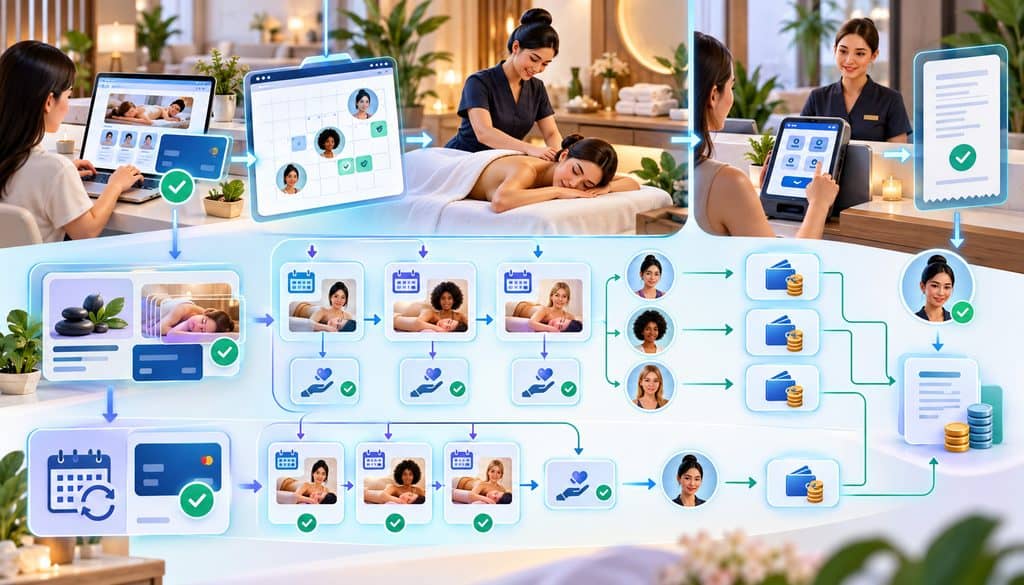
Prepayment is where massage studio tips and service charges become much more complicated than a standard in-person checkout.
When the client pays before arriving, the studio should keep the booking payment, cancellation terms, stored payment method, and post-service checkout workflow coordinated so a prepaid service does not create an unclear second charge or gratuity request after the appointment.
Scenario 1 — Client Prepays the Service and Tip Together
Suppose a client prepays:
- Massage: $120
- Voluntary gratuity: $24
- Total: $144
The system should retain the service and gratuity as separate data fields.
The booking record should also identify the therapist who is expected to perform the appointment. If the assigned therapist changes, the studio needs a procedure for determining whether the customer’s gratuity follows the completed appointment or whether the customer should be asked to confirm the change.
The accounting should never silently treat the entire $144 as massage-service revenue.
Scenario 2 — Client Prepays the Massage but Tips After Treatment
This is often cleaner.
The customer prepays the massage price during booking, then chooses whether to tip after the service.
Possible methods include:
- an in-studio terminal;
- a client-facing mobile checkout link;
- approved post-transaction tip functionality; or
- a separate customer-initiated gratuity transaction.
What should not happen is an employee deciding to charge an extra gratuity to the stored card without appropriate customer authorization.
Scenario 3 — Client Books Online but Pays in Studio
This workflow can accidentally create two tip requests.
For example:
- booking page asks for a tip;
- front-desk terminal asks again after treatment.
A client who tipped during booking may not realize the terminal prompt is asking for a second gratuity.
Configure the systems so staff can see whether a gratuity has already been collected.
If the studio prefers post-treatment gratuities, disable the pre-service tip prompt where the software allows it.
Scenario 4 — Prepaid Appointment Is Canceled or Refunded
A prepaid gratuity needs its own refund procedure.
The studio should determine in advance what happens when:
- the studio cancels the massage;
- the client cancels within the allowed window;
- the client cancels late;
- the therapist is changed;
- the client reschedules;
- only part of the transaction is refunded.
Do not assume a prepaid voluntary gratuity automatically follows the same rule as a deposit, cancellation fee, or service price.
The answer can depend on:
- the client’s authorization;
- the studio’s disclosed refund policy;
- applicable state tip law;
- whether the therapist performed any service;
- whether the therapist already became entitled to the payment; and
- what the payment platform can actually reverse.
Tips on Massage Packages
Packages create an attribution problem because the client pays for services before knowing who may perform each appointment.
Assume a client buys five massages in January and sees three different therapists over the next several months.
If the checkout screen asks for a large “tip” when the package is purchased, which therapist earned it?
Unless the client clearly designated a recipient, the studio should not invent one.
Cleaner options include:
- Do not collect a gratuity when the multi-session package is purchased.
- Offer a voluntary tip after each redeemed appointment.
- Record each gratuity against that specific appointment and therapist.
A package can be paid upfront even though the individual treatments occur weeks or months later, so package billing and appointment-level payment records should remain separate enough to identify which therapist performed each redeemed session and whether the client left a gratuity for that visit.
Package revenue accounting and gratuity attribution are separate questions.
A prepaid package may have its own revenue-recognition treatment, while the tip should still be traceable to the client choice and intended therapist.
Tips on Monthly Massage Memberships
Membership dues are not tips merely because part of the studio’s revenue ultimately funds therapist compensation.
Consider this arrangement:
- Member pays $89 each month.
- Membership includes one massage.
- Member adds a $20 voluntary gratuity after the appointment.
The $89 is membership revenue. The $20 may be a voluntary tip.
Now change the agreement so every member is automatically billed an additional $20 “therapist gratuity” each month with no ability to opt out.
That compulsory amount has the characteristics of a service charge rather than a customer-determined tip.
For recurring plans, membership billing should track scheduled charges separately from individual appointment activity so monthly dues, upgrades, redeemed sessions, and voluntary therapist tips do not collapse into one payment category.
A clean membership record should separately identify:
- recurring membership dues;
- redeemed appointment;
- service upgrade;
- retail purchase;
- voluntary appointment gratuity; and
- any additional compensation the studio independently pays its therapist.
This separation makes massage studio tips and service charges easier to reconcile, refund, report, and audit.
Card-on-File Gratuities Require Separate Authorization Thinking
Studios should distinguish four actions:
- Storing a client’s payment credential.
- Charging membership dues.
- Charging for a booked service.
- Charging a later gratuity.
Those permissions should not be treated as interchangeable.
Visa’s stored-credential framework requires cardholder agreement and proper identification of stored-credential transactions. Merchant-initiated transactions must be linked to an underlying relationship in which the cardholder provided appropriate instructions.
Mastercard’s recurring-payment rules likewise require agreement to the recurring arrangement and disclosure of applicable subscription terms.
A statement such as “we keep your card on file” does not automatically authorize a studio employee to choose a gratuity amount after the treatment.
If the customer wants to leave a gratuity after a prepaid or membership session, the workflow should capture the customer’s actual choice.
Never Store CVV to Make Later Gratuities Easier
A stored-card workflow also creates an important PCI issue.
PCI Security Standards Council guidance classifies CVV/CVC/CID values as sensitive authentication data. PCI DSS prohibits storing those values after authorization—even in encrypted form.
That means a massage studio should not keep:
- CVV in booking notes;
- CVV in a spreadsheet;
- a photograph of a card;
- handwritten card details for future gratuities;
- unprotected PANs in client records; or
- recorded CVV data after authorization.
For recurring clients, secure card-on-file processing should keep sensitive payment credentials inside the payment platform rather than in booking notes, spreadsheets, email, or handwritten records.
Use the payment platform’s tokenized or otherwise compliant card-storage functionality instead of building an informal card-on-file system.
Paying Out Card Tips to W-2 Massage Therapists
For paying out card tips to therapists who are employees, every gratuity should be traceable from payment to employee.
A practical workflow is:
- Match the transaction to the appointment.
- Identify the therapist who performed the service.
- Separate the service price from the voluntary tip.
- Separate tips from mandatory service-charge wages.
- Reconcile refunds and corrected transactions.
- Import or report tip data into payroll.
- Pay the employee within the required timeframe.
- Reconcile payroll totals back to POS and processor totals.
Under federal law, employers generally may not keep employees’ tips. Managers and supervisors also cannot participate in an employee tip pool merely because they help operate the business.
The exact worker and management definitions matter, so studios should avoid treating every lead therapist or shift coordinator as automatically eligible or ineligible without considering actual duties.
Can the Studio Pass Credit-Card Processing Cost on Tips to Therapists?
This issue requires both federal and state analysis.
Under the federal FLSA, an employer may generally reduce a charged tip by no more than the proportionate card transaction fee attributable to that tip, assuming the other federal wage requirements are satisfied.
For example, if the processor actually charges 3% on the transaction, the federal rule can permit an employer to remit 97% of the charged tip rather than absorbing the tip’s proportional processing cost. The employer may not deduct more than the actual proportional transaction fee.
But that is only the federal baseline.
California
California is stricter.
The California Labor Commissioner states that employers must give employees the full amount of a credit-card gratuity and may not deduct credit-card processing costs from it. California also requires credit-card gratuities to be paid no later than the next regular payday following authorization.
A California massage studio therefore should not use the federal proportional-fee rule as its policy.
Massachusetts
Massachusetts also has a more protective Tips Law.
The Massachusetts Attorney General’s updated September 2025 advisory states that employers may not keep a covered employee’s tips or demand, request, or accept a portion of a tip. The law also governs certain charges that customers would reasonably expect to go to service employees.
Massage studios operating there should evaluate whether their therapists qualify as covered service employees and how the studio describes mandatory charges to customers.
New York Requires Industry-Specific Care
New York’s general Labor Law §196-d prohibits employers from demanding or accepting part of an employee’s gratuity or retaining part of a charge purported to be a gratuity.
New York’s hospitality wage order, however, contains a specific rule allowing hospitality employers to deduct the proportional credit-card processing cost from a charged tip.
A massage studio should not automatically assume that restaurant-specific hospitality rule applies to it. New York’s treatment depends on the applicable wage order and industry classification.
Practical Rule
Never write a nationwide employee handbook rule saying:
“We deduct 3% from all card tips.”
Instead verify:
- the studio’s state;
- the worker’s legal status;
- the law governing that occupation/industry;
- the actual processing cost; and
- whether the state prohibits any deduction at all.
Tip Payment Timing Is Also a Wage-Law Issue
Processor settlement timing is not necessarily the legal deadline for employee payment.
Federal DOL guidance says an employer cannot indefinitely hold a card tip while waiting for the processor to reimburse or settle the transaction; the employee must receive amounts owed under the federal rule no later than the regular payday.
California provides an even more specific statutory rule for credit-card gratuities: payment by the next regular payday after the patron authorized the card payment.
Studios operating in other states should verify their own payday and gratuity statutes.
That makes “we don’t pay tips until the deposit clears” a poor default policy unless applicable law actually permits that timing.
What Changes When the Therapist Is a Booth Renter or Independent Contractor?
This is one of the most important distinctions in massage studio tips and service charges.
“Booth renter,” “room renter,” and “1099 therapist” are not legal worker-classification tests.
A contract cannot turn an employee into an independent contractor if the actual working relationship indicates otherwise.
IRS Classification
For federal employment-tax purposes, the IRS evaluates the underlying relationship, including:
- behavioral control;
- financial control; and
- the type of relationship between the parties.
Relevant facts can include instructions, training, investment, opportunity for profit or loss, permanency, benefits, and whether the services are a key part of the business.
Department of Labor Status in 2026
Federal wage-law classification is currently in a changing regulatory environment.
On February 26, 2026, the Department of Labor proposed replacing its 2024 independent-contractor rule with a streamlined economic-reality analysis. The proposal identifies factors such as control, opportunity for profit or loss, skill, permanence, and integration of the work.
As of September 29, 2026, that February proposal remains a proposed rule, not a finalized replacement rule.
The Department also says it is no longer applying the 2024 rule in its current investigations.
State worker-classification statutes may use different or stricter tests.
For that reason, a studio should never conclude:
“She rents a room, so she is automatically an independent contractor.”
If the Therapist Is Genuinely Self-Employed
After classification is established, determine what payment model actually exists.
There are at least two different arrangements.
Model A — Studio Sells the Massage
The studio is merchant of record.
The client buys the service from the studio. The studio collects the service charge and gratuity, controls refunds, and later pays the independent therapist under the contractor agreement.
Model B — Therapist Sells the Massage
The therapist operates their own business and is the underlying service provider. The studio may simply provide premises, software, or payment collection.
Those structures can create different reporting and accounting consequences.
Document:
- who is merchant of record;
- whose name is on the receipt;
- who sets the price;
- who contracts with the client;
- who decides refunds;
- who carries chargeback risk;
- who owns the service revenue;
- who earns the gratuity;
- when the studio remits funds; and
- which information-return rule applies.
Do not automatically put every contractor gratuity on Form 1099-NEC.
Beginning with 2026 reporting, IRS information-return rules specifically accommodate separate reporting of certain cash tips and tipped occupation codes on Forms 1099-NEC, 1099-MISC, and 1099-K. Which form applies depends on the actual payment arrangement.
That is another reason the merchant-of-record structure matters.
Employee Tip vs Contractor Gratuity
| Issue | W-2 Massage Therapist | Genuine Independent Therapist |
| Worker status | Employee | Separate self-employed business |
| Voluntary client tip | Employee tip | Income treatment depends on actual payment structure |
| Mandatory service-charge distribution | Generally wages | Governed by contract/business structure and applicable tax rules |
| Payroll withholding | Employer payroll rules apply | Generally not employee payroll withholding |
| Tip ownership | Federal/state wage protections may apply | Contract and applicable business/tax law matter |
| Merchant settlement | Usually settles to studio | Depends on merchant-of-record setup |
| Information reporting | W-2 tip/wage reporting | May involve applicable 1099 reporting depending on transaction flow |
| 2026 tipped occupation code | TTOC 602 where applicable | TTOC 602 may also be relevant to qualifying reported tips |
| Worker classification | Employment relationship controls | Must genuinely satisfy federal and state contractor standards |
Avoid Double Tip Prompts
Massage studios often have more payment touchpoints than they realize.
A client may encounter:
- booking checkout;
- deposit request;
- prepayment page;
- front-desk terminal;
- mobile checkout;
- card-on-file payment;
- emailed payment link.
A single integrated checkout path linking scheduling, client records, payment, and receipts also makes it easier for front-desk staff to see whether a tip was already entered online before presenting another gratuity screen.
If three of those systems independently ask for a tip, the checkout experience can become confusing or feel coercive.
Map the client journey before enabling tip prompts.
A Better Configuration
- Online booking: Decide whether tipping makes sense before the service occurs.
- Prepayment: If the client chooses a tip, record it separately.
- Check-in: Do not ask again unless the client understands the prior tip can be changed.
- Post-treatment checkout: Use this as the primary tip opportunity when that fits the business model.
- Receipt: Show the service amount, compulsory charges, voluntary tip, and final total clearly.
- Payroll: Connect the voluntary tip to the therapist.
- Reconciliation: Flag duplicated gratuities, refunded gratuities, and unattributed tips.
Preset percentages do not automatically make a gratuity compulsory.
A screen offering 15%, 20%, 25%, custom, and no tip can still allow a voluntary choice.
A screen that refuses to process payment until the customer chooses a nonzero amount raises a very different federal tax question.
How to Reconcile Massage Studio Tips and Service Charges
A studio should be able to reproduce the money trail for any appointment.
For each reporting period, reconcile:
| Record | What to Confirm |
| Booking system | Therapist, service, package/membership status |
| POS/terminal | Service amount, mandatory charge, voluntary tip |
| Processor report | Gross transaction, refunds, reversals |
| Bank settlement | Deposited net amount |
| Payroll | Employee tips and service-charge wages |
| Contractor payout | Amount remitted under applicable contract |
| Refund log | Which portion was refunded and why |
A common mistake is comparing the bank deposit directly with therapist tips.
The processor may net card fees, refunds, chargebacks, adjustments, or other transactions before settlement. Payroll should therefore reconcile against transaction-level source data rather than assuming every bank deposit maps directly to tips.
A Massage Studio Tip and Service-Charge Setup Checklist
Before changing a gratuity policy, verify that:
- voluntary tips and mandatory service charges have different accounting codes;
- the customer can genuinely decline a voluntary tip;
- compulsory charges are not labeled in a misleading way;
- prepaid tips remain linked to the relevant appointment;
- package tips can be attributed to the correct therapist;
- membership dues are not recorded as tips;
- stored-card gratuities require appropriate client authorization;
- CVV is never retained after authorization;
- card tips reconcile to payroll;
- service-charge distributions enter employee payroll as wages;
- refunds include a defined gratuity procedure;
- managers and supervisors are not improperly retaining employee tips;
- credit-card fee deductions have been checked against state law;
- employee tip timing satisfies applicable payday rules;
- the studio has verified its tip-adjust capability with its processor/acquirer;
- worker classification has been reviewed independently of the “booth renter” label;
- contractor merchant-of-record arrangements are documented; and
- 2026 payroll reporting supports the new tip and TTOC fields.
Frequently Asked Questions
Is an automatic gratuity at a massage studio considered a tip?
Usually not when the client is required to pay it. Current IRS guidance classifies mandatory service charges and auto-gratuities separately from voluntary tips. The business cannot change that result merely by describing the payment as a gratuity.
Are massage therapist credit-card tips taxable?
Yes. Credit- and debit-card tips are included in federal cash-tip reporting rules. They remain income and generally continue to be subject to applicable payroll-tax rules even though certain eligible workers may separately qualify for the federal qualified-tip deduction.
Do massage therapists qualify for the federal qualified-tip deduction?
Massage therapists are specifically listed in the IRS’s final tipped-occupation list as TTOC 602. Whether an individual tip qualifies still depends on the statutory requirements, including whether it was genuinely voluntary.
Does the new tip deduction mean massage studios stop withholding taxes on tips?
No. The 2026 Form W-2 instructions state that tips generally remain subject to applicable federal income-tax withholding and Social Security and Medicare taxation even though eligible workers may claim the qualified-tip deduction on their individual return.
Can a studio put automatic gratuities into the same payroll field as tips?
That is generally the wrong approach. Distributed compulsory service charges are generally wages, while voluntary customer tips follow tip-reporting rules. Separate payroll codes make reporting and reconciliation substantially clearer.
Can a massage studio deduct card-processing fees from therapist tips?
Federal law can permit deduction of the proportional card-processing cost attributable to a tip, subject to its limitations. State law may prohibit it. California expressly requires employers to pay employees the full credit-card gratuity without deducting processing costs.
When must a studio pay credit-card tips to employees?
Federal DOL guidance says an employer cannot hold charged tips indefinitely while waiting for processor reimbursement and states that amounts due must be paid no later than the regular payday. States may impose their own rules; California specifically requires payment by the next regular payday after the patron authorizes the credit-card payment.
Can clients tip when a massage is prepaid?
Yes. The gratuity can still be voluntary when the underlying massage was prepaid. The studio should separately record the tip and preserve its connection to the appointment and therapist.
Should a five-session massage package collect one tip when the package is purchased?
Usually a cleaner operational design is to ask for a voluntary gratuity when each service is redeemed. That avoids guessing which therapist the client intended to reward.
Can a studio charge a recurring gratuity with a massage membership?
A compulsory recurring amount may be a service charge rather than a tip. The studio should also distinguish authorization to charge membership dues from authorization to charge an additional gratuity.
Does having a client’s card on file allow the studio to add a gratuity later?
Not automatically. Card-on-file and stored-credential arrangements depend on the cardholder’s agreement and the type of transaction being processed. A later gratuity should have its own clear customer authorization.
Can the studio keep the client’s CVV for future membership or tip payments?
No. PCI DSS prohibits storing card verification codes after authorization, including for card-on-file or recurring-payment purposes.
Is a booth-renter massage therapist automatically an independent contractor?
No. Worker status depends on the actual economic and working relationship under applicable federal and state law. Renting treatment space or receiving a Form 1099 does not by itself establish independent-contractor status.
Should every independent therapist’s gratuity be reported on Form 1099-NEC?
Not automatically. The correct information-return treatment depends on the payment arrangement, including who made the payment and whether a payment settlement entity processed it. The 2026 Forms 1099 rules now also include fields for cash tips and Treasury Tipped Occupation Codes.
Can a massage studio require clients to select at least a small tip before completing checkout?
Doing so undermines the voluntary nature of the payment. Current IRS guidance specifically identifies a digital payment prompt requiring a customer to select a tip greater than zero as an example of a service charge rather than a voluntary tip.
What records should a studio keep for massage studio tips and service charges?
At minimum, the studio should be able to connect the appointment, therapist, service amount, mandatory fees, voluntary gratuity, refund history, payment transaction, payroll or contractor payout, and settlement record. The goal is to reconstruct who paid what, why it was paid, and who ultimately received it.
Build the Payment Workflow Around the Nature of the Money
The best way to manage massage studio tips and service charges is to decide what each payment actually represents before deciding how the software should process it.
A genuine tip begins with customer choice. A mandatory auto-gratuity or required therapist charge is a different type of payment even when the studio intends to distribute all of it to the therapist.
That distinction then controls the rest of the workflow.
Voluntary employee card tips need accurate therapist attribution, payroll reporting, payout, and reconciliation. Mandatory service-charge distributions generally belong in wage payroll rather than the tip bucket. Packages and memberships require appointment-level attribution so a gratuity does not become detached from the person who actually performed the service.
Stored cards add another layer: permission to keep a credential is not unlimited permission to charge future gratuities. Tip-adjust functionality should be used only where the processor, acquirer, card-network rules, and studio’s payment setup support it.
Worker classification matters just as much. A W-2 therapist and a genuine independent massage business can receive money through very different legal and reporting structures, and calling someone a booth renter does not settle that question.
Finally, the federal rules are only the starting point. California, Massachusetts, New York, and other states can impose stricter requirements on tip ownership, deductions, service charges, and payout timing.
A strong studio system therefore keeps five things separate and traceable:
the massage price, mandatory fees, voluntary gratuities, worker compensation, and payment settlement.
When those records stay separate, owners can explain what the client chose, what the business required, who earned the payment, how it was reported, and where the money ultimately went. That is the foundation of a readable receipt for the client, accurate payroll for the therapist, and a defensible accounting trail for the studio.