
By Lauren Knight September 29, 2026
HSA FSA cards for massage therapy may be used when the expense qualifies as medical care rather than general wellness, but eligibility and card approval are separate issues. Medical documentation may support a claim, while the merchant category, card issuer, benefit plan, and payment setup can still determine whether a benefit card approves at checkout.
For massage studios, the most important rule is not to treat “eligible expense,” “doctor recommended,” “card approved,” and “FSA reimbursed” as interchangeable terms. They answer different questions.
Under Internal Revenue Code §213(d), medical care includes amounts paid for diagnosis, cure, mitigation, treatment or prevention of disease, or for affecting a structure or function of the body. Current IRS Publication 502 adds an important limit: expenses must be primarily for medical care and do not qualify merely because they are beneficial to general health.
That distinction is the foundation for understanding HSA FSA cards for massage therapy.
HSA/FSA Massage Payments at a Glance
| Situation | Medical-Expense Question | Card-Acceptance Question | Practical Next Step |
| Relaxation massage | Usually primarily general wellness | Benefit card may decline | Use ordinary payment |
| Routine wellness massage | Medical-care standard may not be met | Approval would not prove eligibility | Do not promise HSA/FSA eligibility |
| Massage used as medical treatment | May potentially satisfy §213(d), depending on facts | Benefit card can still decline | Keep supporting documentation |
| Client has an LMN | May help establish medical purpose | LMN does not reconfigure the merchant account | Follow plan requirements |
| FSA card declines | Expense could still potentially qualify | MCC, issuer or substantiation controls may be involved | Pay normally and submit a claim if permitted |
| HSA card declines | Tax eligibility and card controls remain separate | HSA custodians may restrict their debit cards | Use another payment method and retain records |
| Mixed massage, gratuity and spa add-ons | Components should not automatically be treated alike | Mixed total can complicate payment | Itemize charges |
| Client pays personally | Qualified-expense analysis still applies | POS benefit-card acceptance no longer controls | Use appropriate reimbursement process |
The distinction matters because IRS rules governing a health FSA debit card are not identical to the rules governing an HSA distribution. Current IRS Publication 969 addresses them separately.
When Is Massage Therapy HSA/FSA Eligible?
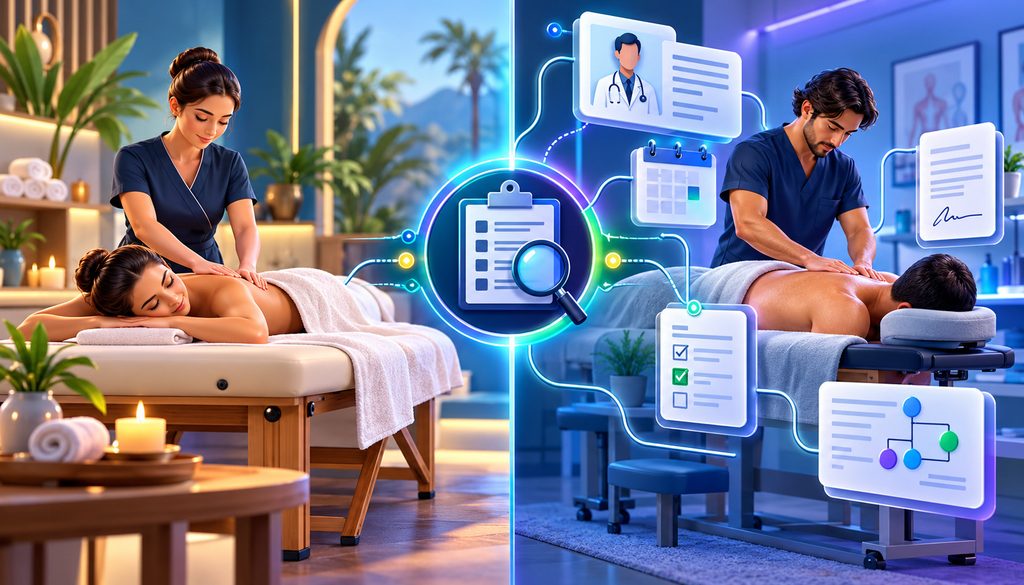
The starting point is the federal definition of medical care. Under Internal Revenue Code §213(d), medical care includes amounts paid for diagnosis, cure, mitigation, treatment or prevention of disease, as well as amounts paid for the purpose of affecting a structure or function of the body.
The IRS applies an additional practical distinction: Publication 502 says medical expenses must be primarily for medical care and not merely beneficial to general health. That is why the purpose of a massage matters more than simply describing the service as therapeutic.
Publication 502 uses essentially the same framework and says medical expenses must be primarily to alleviate or prevent physical or mental illness or disability. Expenses that are merely beneficial to general health do not satisfy that test.
Publication 502 also separately states that amounts paid for therapy received as medical treatment can be included as medical expenses. That language supports a facts-and-purpose analysis rather than a blanket rule for every service that might be described as therapeutic.
Massage Primarily for General Wellness
A relaxation massage purchased because a client wants to unwind is different from treatment undertaken primarily for a medical purpose.
Examples that should not automatically be represented as qualified medical care include:
- general relaxation;
- routine self-care;
- massage purchased as a spa experience;
- general stress reduction with no medical-treatment context;
- wellness packages;
- luxury enhancements;
- services purchased simply because they make the client feel better.
Publication 502 specifically excludes expenses that are merely beneficial to general health. It makes similar distinctions elsewhere for health-club dues and activities undertaken only to improve general health.
That does not mean a relaxation-oriented massage has no health benefit. It means “beneficial to health” and “qualified medical expense under §213(d)” are not the same legal standard.
Massage Primarily for Treatment of a Medical Condition
The analysis becomes stronger when massage is genuinely being received as medical treatment for a particular condition and the facts support that purpose.
For example, a client may have documentation showing that a healthcare practitioner recommended massage as one component of treatment for a diagnosed condition. That creates a different factual context than a client purchasing a massage simply for relaxation.
The studio should still avoid making the final tax determination.
A useful distinction is:
A massage studio documents what service it actually provided. The client and, where applicable, the FSA plan administrator determine whether the expense satisfies the applicable medical-expense rules.
This approach protects both the client and the studio from turning a payment conversation into unsupported tax advice.
Does a Letter of Medical Necessity Make Massage Eligible?

No. A letter of medical necessity can support a client’s position that massage was primarily for a medical purpose, but an LMN does not automatically make the expense qualified and does not guarantee reimbursement.
There is also no blanket IRS rule saying, “Every massage requires an LMN.”
The primary IRS authorities use the §213(d) medical-care standard. They do not create a massage-specific formula under which adding an LMN automatically converts the service into a qualified expense.
An FSA administrator may nevertheless require additional documentation under its plan procedures. That requirement should be confirmed with the particular administrator.
Commonly Useful LMN Information
| Information | Why It May Be Useful |
| Patient identity | Connects the documentation to the person receiving care |
| Medical condition | Provides the medical context |
| Recommended treatment | Explains why massage is being used |
| Medical purpose | Helps distinguish treatment from general wellness |
| Expected frequency | May document a planned course of treatment |
| Expected duration | May clarify the period for which treatment is recommended |
| Practitioner name/signature | Identifies who made the recommendation |
| Date | Shows when the recommendation was issued |
These are commonly useful documentation elements, not a universal IRS checklist that every massage client must satisfy.
Who Should Write an LMN?
That depends on the administrator or plan requesting it.
A plan may require documentation from a physician or another appropriately licensed healthcare practitioner. Studios therefore should not tell a client that a note from any massage therapist will necessarily satisfy the administrator.
A massage therapist can provide truthful documentation about services actually rendered. The therapist should not invent diagnoses, claim authority the therapist does not possess under applicable professional rules, or create a backdated medical-necessity document merely to obtain reimbursement.
HSA vs. Health FSA: Similar Medical-Expense Standard, Different Administration
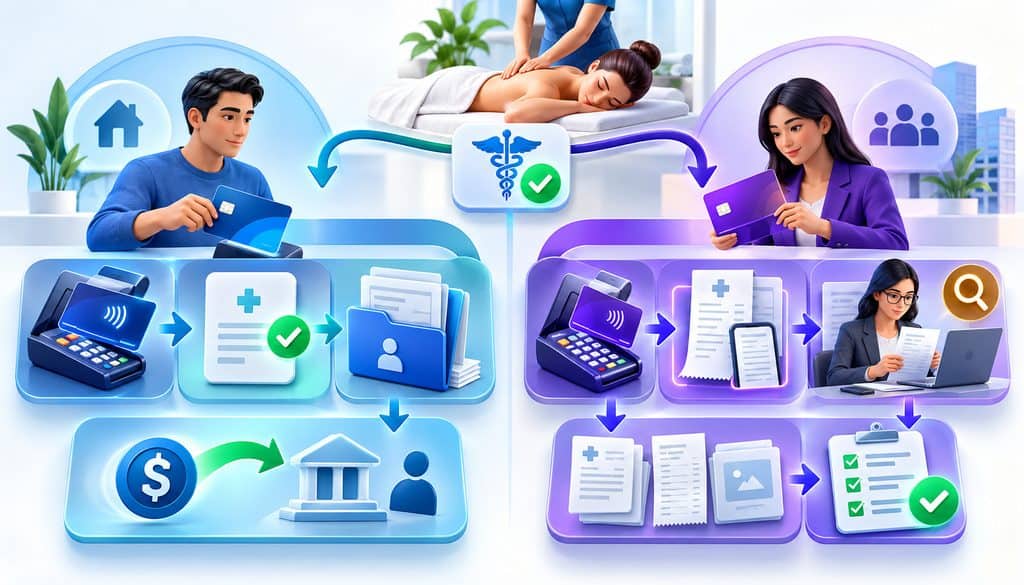
This is one of the most important distinctions in the entire article.
| Issue | HSA | Health FSA |
| Core medical-expense concept | Qualified medical expenses generally reference §213(d) | Reimbursable medical expenses generally reference §213(d) and plan terms |
| Who owns the funds/account | Individual account beneficiary | Employer-sponsored benefit arrangement |
| Debit card possible | Yes | Yes |
| Who is responsible for HSA tax treatment | Account beneficiary | Not the same structure; plan must substantiate reimbursements |
| POS card restriction | Custodian/card program may impose restrictions | IRS debit-card framework expressly includes merchant/MCC controls |
| Documentation | HSA holder must retain sufficient records | Plan generally requires substantiation |
| Later reimbursement | HSA distribution may reimburse qualifying expenses subject to HSA rules | Claim must satisfy plan rules and claim deadlines |
| Card approval proves eligibility? | No | No |
HSA Rules
For an HSA, distributions used to pay qualified medical expenses can generally be tax-free. Current IRS Publication 969 explains both the qualified-medical-expense requirement and the account holder’s recordkeeping responsibility.
The HSA owner should retain records showing that the expense was qualified, was not reimbursed from another source, and was not also claimed as an itemized medical deduction.
Section 223 defines qualified HSA medical expenses by reference to medical care under §213(d). Tax-free treatment generally applies when an HSA distribution is used exclusively for qualified medical expenses.
Publication 969 also states that the HSA holder must retain sufficient records showing that distributions were for qualified medical expenses, that those expenses were not reimbursed from another source, and that they were not also taken as an itemized medical deduction.
That creates an important operational difference.
An HSA debit card transaction is a distribution from the HSA, but the fact that the card authorized does not transform an otherwise nonqualified purchase into a qualified medical expense.
Likewise, a decline does not necessarily establish that the expense is nonqualified.
IRS Notice 2008-59 confirms that an HSA may use a debit card that restricts payment to healthcare transactions, provided the account beneficiary also has another way to access the HSA funds.
So an HSA debit card declined massage transaction can sometimes reflect card-program controls rather than a final federal tax determination.
Health FSA Rules
A health FSA works differently.
Current Publication 969 says qualified FSA medical expenses are expenses specified by the plan that would generally qualify for the medical and dental expense deduction. It also states that expenses generally must be substantiated.
The IRS has developed specific rules for FSA/HRA debit-card transactions, including merchant-category restrictions and permitted substantiation methods.
That is why an FSA debit card declined massage transaction deserves separate treatment from an HSA card decline.
Why HSA/FSA Cards Often Decline at Massage Studios
There is no single universal reason.
A decline can involve:
- merchant category classification;
- issuer or benefit administrator controls;
- health FSA merchant restrictions;
- HSA custodian card controls;
- merchant-account configuration;
- insufficient available balance;
- ordinary issuer fraud controls;
- mixed purchases;
- terminal or processor problems;
- plan-specific restrictions.
A studio should therefore avoid telling the client, “Your massage isn’t eligible” merely because the terminal returned a decline.
For health FSAs and HRAs specifically, IRS Notice 2007-2 says debit-card use is restricted to healthcare-related merchant categories unless an applicable IIAS pathway is used.
The same notice should not be casually described as a universal HSA debit-card rule. HSA distributions operate under the separate HSA framework described above.
When benefit cards are only one of several payment methods offered at the front desk, the studio should make sure its in-studio checkout workflow can handle card declines, split payments, stored payment methods, refunds, and receipt delivery. That keeps an HSA/FSA decline from disrupting the rest of the appointment checkout process.
Merchant Category Codes Matter — But MCC Does Not Determine Medical Eligibility
An MCC is a merchant-category classification used in card processing.
For FSA/HRA debit-card rules, merchant category information matters because IRS guidance expressly limits card use to healthcare-related merchants and certain other merchants meeting specified requirements.
But an MCC answers a merchant-classification question. It does not answer whether this particular massage is a qualified medical expense.
That gives studios two rules to follow:
- The merchant account should accurately represent the actual business.
- The studio should not treat its MCC as an IRS ruling on each client’s massage.
Never Request a False Medical MCC
Do not ask a processor to code an ordinary spa as a medical practice merely to obtain benefit-card approvals.
SIGIS itself emphasizes that properly assigned MCCs should follow card-network/acquirer classification rules. Its current guidance also warns that merely assigning a pharmacy MCC to a business that is not actually a qualifying pharmacy does not make the merchant eligible for the pharmacy 90% program.
If a studio believes its MCC is factually wrong, it can ask the acquirer to review it. That is different from asking for a convenient but inaccurate code.
A practitioner reviewing the merchant account should also confirm that card data is handled through secure processing tools rather than being manually recorded or stored. Accurate merchant classification and secure card handling solve different problems, but both belong in the studio’s payment-control checklist.
SIGIS, IIAS, and the 90% Rule: What Actually Applies?
This is an area where inaccurate online explanations are common.
The 90% rule is not a general rule allowing a massage studio to accept health-benefit cards because 90% of its services are therapeutic.
IRS Notice 2007-2 specifically addresses stores operating under Drug Stores and Pharmacies merchant categories. It provides an alternative to IIAS when, on a location-by-location basis, 90% of the store’s prior-year gross receipts consist of qualifying §213(d) medical items.
Current SIGIS merchant guidance is even more explicit.
SIGIS states that the only merchants eligible to register in its 90% Rule program are qualifying drug stores and pharmacies. Its currently published eligible MCCs are 5912 and 5122.
Therefore:
A massage studio cannot use the SIGIS 90% rule simply because most of its revenue comes from massage or because management considers most massages therapeutic.
What Is IIAS?
IIAS stands for Inventory Information Approval System.
IRS Notice 2006-69 established the inventory-based approach for identifying qualifying healthcare merchandise at the point of sale. The system can identify which items in a shopping basket satisfy the applicable eligibility rules and limit the healthcare-card amount accordingly.
Current SIGIS guidance describes IIAS as a combination of inventory management, POS processing and recordkeeping used to verify eligible healthcare products.
That distinction matters for massage businesses.
IIAS is not a piece of software that changes a relaxation massage into medical treatment. Installing or participating in an IIAS program does not itself resolve whether a massage service meets §213(d).
Does a Massage Studio Need SIGIS Registration?
Do not use a blanket “yes.”
SIGIS provides certification and registration programs for merchants operating within its IIAS and 90% frameworks. Whether those pathways apply depends on the merchant’s actual model, classification, products, acquirer and transaction flow.
A massage-service business should first ask its acquirer:
- what MCC is assigned;
- whether that classification is correct;
- how its health-benefit card acceptance is configured;
- whether any SIGIS program actually applies;
- whether the business sells healthcare products that create separate IIAS considerations.
This is far safer than registering for a program based on an online claim that “all HSA/FSA merchants need SIGIS.”
HSA FSA Cards for Massage Therapy: How a Transaction Actually Moves
Understanding the payment flow prevents staff from oversimplifying a decline.
A normal transaction can involve several independent layers:
- The client presents the benefit card.
- The terminal submits the transaction.
- The processor and acquirer route the authorization.
- Merchant data, including classification information, travels with the transaction.
- The issuer or benefit-card program applies its authorization controls.
- The transaction is approved or declined.
- For a health FSA, additional substantiation may still be required unless an approved substantiation method applies.
- For an HSA, the account holder still bears responsibility for qualified use and recordkeeping.
The studio’s ordinary terminal should also be configured for the payment methods clients actually use. EMV and contactless payment setup can improve everyday card acceptance and transaction tracking, but neither EMV nor tap-to-pay bypasses the separate authorization controls applied to an HSA or FSA benefit card.
This can be summarized as:
Client → terminal → processor/acquirer → card/benefit controls → approval or decline → separate eligibility/recordkeeping or substantiation obligations
IRS Chief Counsel explained in 2021 that an FSA debit-card transaction may reveal only the transaction amount, general merchant category and provider—not necessarily the actual service purchased. When that information does not satisfy substantiation requirements, the administrator must obtain further information.
That is an authoritative reason not to write:
“The FSA card approved, so the massage was proven eligible.”
It was not.
Questions to Ask Your Processor Before Advertising HSA/FSA Acceptance
A massage studio considering accepting HSA cards at a spa or massage practice should obtain clear answers before placing broad claims on its website.
Merchant Account Checklist
- What MCC is assigned to this merchant account?
- Does the MCC accurately reflect our primary business activity?
- Does your platform support HSA cards?
- Does your platform support health FSA cards?
- Are the acceptance requirements different for HSA and FSA transactions?
- Does our merchant classification qualify as a healthcare-related MCC for FSA/HRA card purposes?
- Does any SIGIS requirement apply to our business?
- Does IIAS apply only to eligible products we sell?
- Does the terminal support split tender?
- How does the platform handle partial authorization?
- Can staff distinguish a normal issuer decline from a benefit-card restriction?
- Is any additional underwriting or merchant setup required?
The required payment setup can also change with the size of the practice. An independent therapist may need a relatively simple terminal and booking integration, while a larger operation may need centralized payment reporting and consistent checkout workflows across multiple massage-clinic locations.
What Documentation Does an FSA Claim Actually Need?
For health FSA reimbursement, substantiation is a core requirement.
IRS Chief Counsel’s 2021 explanation says independent third-party information used for medical-expense substantiation includes:
- a description of the service or product;
- the date of service or sale;
- the amount of the expense.
Proposed §125 regulations and IRS guidance also require substantiation rather than allowing administrators simply to assume that every transaction at a potentially medical merchant is qualified.
Depending on the nature of the expense and the plan, the client may also need medical-necessity documentation.
Client Documentation Checklist
A client seeking reimbursement should consider retaining:
- itemized studio receipt;
- service date;
- service description;
- amount paid;
- provider or practitioner name where relevant;
- proof of payment;
- LMN or comparable medical documentation where required;
- any claim form required by the administrator;
- correspondence requesting additional substantiation.
The massage studio does not need to determine which of these documents establishes tax eligibility. Its job is to produce accurate transaction and service documentation.
What Should the Massage Studio Keep?
The studio’s recordkeeping function is different from the client’s.
Useful business records include:
- appointment date;
- client or transaction identifier;
- actual service provided;
- practitioner;
- amount charged;
- gratuity recorded separately where applicable;
- retail items or add-ons separately identified;
- payment method;
- receipt;
- refunds or adjustments.
Studios should not collect diagnoses merely to make payment cards work.
They should also avoid unnecessary health-data retention. HIPAA does not automatically apply to every massage studio simply because clients discuss health conditions; HIPAA applicability depends on whether the business is a covered entity or business associate and on the activities involved.
What an HSA/FSA-Friendly Itemized Massage Receipt Should Include
A well-designed receipt helps the client substantiate what actually happened without turning the studio into a tax adviser.
| Receipt Field | Recommended Practice |
| Studio name | Use actual legal or trade name |
| Date | Show actual date of service |
| Service | Describe the actual massage provided |
| Practitioner | Include where appropriate |
| Amount | Clearly itemize the service charge |
| Gratuity | Show separately rather than blending into service price |
| Add-ons | Itemize separately |
| Retail products | Identify separately |
| Payment status | Show amount paid/refunded |
Do not insert false diagnosis codes.
Do not rename a relaxation massage “medical rehabilitation” because the client wants reimbursement.
Do not write “HSA approved” on the receipt unless the phrase has a specific, accurate operational meaning in your system—and even then, card acceptance should not be described as a determination of federal tax eligibility.
A consistent checkout process should make it easy to issue digital receipts and keep payment records tied to the client transaction. That is especially useful when a client later needs an itemized record for an HSA file or an FSA reimbursement request.
Card Declined? Use This HSA/FSA Massage Decision Workflow
1. Do Not Keep Running the Card
Repeated attempts rarely fix a merchant-category restriction or benefit-card control.
They can also create confusing duplicate authorization activity.
2. Check the Transaction Total
Determine whether the charge combines the massage with:
- gratuity;
- aromatherapy;
- retail products;
- cosmetic spa services;
- package purchases;
- memberships;
- gift cards;
- unrelated wellness services.
A mixed transaction may create complications even when one component may potentially qualify.
3. Itemize or Separate Charges Where Appropriate
Suppose the appointment includes:
- $120 massage service;
- $25 gratuity;
- $20 optional wellness enhancement.
Operationally, the studio may separate those amounts if its system supports doing so.
That does not mean the studio has ruled that the $120 is qualified medical care. It simply prevents unrelated amounts from being blended into a single charge.
4. Do Not Diagnose the Decline at the Front Desk
Staff can say:
“The card did not approve here. Benefit-card approval can depend on the card program and merchant setup, so the decline does not necessarily tell us whether your expense qualifies.”
That is more accurate than saying, “Your FSA rejected massage.”
5. Use an Ordinary Payment Method
The client can pay by a regular credit/debit card, cash or another payment method accepted by the studio.
If the benefit card cannot be used, the studio can still complete checkout through an ordinary card or wallet payment. Supporting mobile wallets, contactless cards, and portable payment methods gives clients a practical fallback without requiring the front desk to keep retrying the declined benefit card.
6. Issue an Itemized Receipt
The client can then use the appropriate HSA recordkeeping or FSA claim process.
7. Let the Client Resolve Eligibility With the Proper Party
For an FSA, that generally means the plan administrator.
For an HSA, the account holder is ultimately responsible for qualified-distribution treatment and recordkeeping under the federal HSA rules.
Pay Normally and Seek Reimbursement: A Critical Fallback
A benefit card does not have to be the only pathway.
HSA Example
A client’s HSA debit card fails at the studio. The client pays with a regular card.
If the expense is a qualified medical expense incurred after the HSA was established and the other HSA rules are met, Publication 969 explains that the account holder can receive a tax-free HSA distribution to pay or reimburse qualified medical expenses. The holder must retain supporting records.
The studio should not promise that the particular massage qualifies.
Health FSA Example
A client’s FSA debit card declines. The client pays normally and obtains an itemized receipt.
The client may then submit a claim through the health FSA’s ordinary reimbursement procedure if the expense was incurred during the appropriate coverage period and satisfies the plan’s eligibility and substantiation requirements.
Unlike an HSA, an FSA is subject to its plan’s claim procedures and deadlines. A studio should therefore avoid telling clients that they can submit a receipt “whenever they want.”
Prepaid Packages and Massage Memberships Need Extra Care
A common question is whether clients can use HSA FSA cards for massage therapy packages, memberships or prepaid sessions.
Do not assume that paying in advance makes future services immediately reimbursable.
Publication 969 states that a health FSA cannot make advance reimbursements of future or projected expenses.
This matters if the studio sells a package of five future massages or charges a monthly membership fee before services are actually received.
The payment structure and the date the medical expense is considered incurred can differ from a normal pay-at-appointment transaction.
Studios that sell packages or monthly plans also need to separate the tax question from the billing mechanics. A recurring billing setup for massage memberships and prepaid packages can automate scheduled charges, but the existence of a membership or package does not make future massage sessions HSA/FSA-qualified.
The same distinction matters when a studio collects money before an appointment. A deposit or prepayment policy can secure the booking and define what happens after a cancellation or no-show, but collecting that amount in advance does not itself establish when an HSA/FSA-qualified medical expense has been incurred.
What the Studio Must Never Do
| Bad Practice | Why It Creates Risk | Correct Approach |
| Change the business to a false medical MCC | Misrepresents actual merchant activity | Correct only genuinely inaccurate classification |
| Call every massage “medical treatment” | Service record becomes misleading | Describe what was actually provided |
| Fabricate a diagnosis | False documentation | Leave diagnosis to qualified practitioners |
| Create a fake LMN | False substantiation | Request legitimate documentation where required |
| Backdate medical paperwork | Misrepresents timing | Use accurate dates |
| Blend gratuity into a supposed medical charge | Obscures the nature of the expense | Itemize gratuity separately |
| Split payments solely to evade benefit controls | Circumvents safeguards | Split only for legitimate itemization/payment reasons |
| Say “card approved = IRS approved” | Authorization is not a tax ruling | Separate payment from eligibility |
| Apply the SIGIS 90% rule to massage revenue | Misstates the rule | Limit it to qualifying pharmacies/drug stores |
| Install IIAS and call massage eligible | Confuses inventory substantiation with service eligibility | Apply IIAS only where genuinely applicable |
How to Market HSA/FSA Payment Options Without Overpromising
Studios should use precise language.
Avoid:
“All massages are HSA/FSA eligible.”
Avoid:
“Bring an LMN and your massage is covered.”
Avoid:
“We are HSA/FSA certified.”
Instead, explain three separate concepts:
- Some massage expenses may potentially qualify when primarily incurred for medical care.
- Direct benefit-card acceptance depends on the card and merchant setup.
- Itemized receipts are available for clients who need documentation.
That gives clients useful information without making a tax guarantee.
Suggested Booking-Page Policy
HSA/FSA Payment Information
Some massage expenses may qualify as medical expenses when they are incurred primarily for medical care rather than general wellness. Eligibility depends on your individual circumstances and the requirements of your HSA or FSA. Medical-necessity documentation may be requested in some situations. Direct HSA or FSA card approval also depends on the card program and our merchant-payment configuration, so a card may decline even when you plan to seek reimbursement. We can provide an itemized receipt showing the actual service, date and amount paid. Please confirm eligibility and documentation requirements with your HSA custodian or FSA administrator. Our studio does not determine individual tax eligibility.
Front-Desk Script for HSA/FSA Questions
“Some massage expenses may qualify when they are primarily for medical care, but we can’t determine your individual HSA or FSA eligibility. You can try your benefit card if our payment setup supports it. If it doesn’t approve, you can pay normally and we’ll provide an itemized receipt for your records or reimbursement request.”
This script keeps the answer helpful without turning front-desk employees into benefits administrators.
Hypothetical Example 1: Medical Purpose, FSA Card Declines
A client is receiving massage as part of treatment for a documented medical condition. The client has medical-necessity documentation that the FSA administrator may consider.
The studio’s merchant setup, however, is not accepted by that FSA card program and the transaction declines.
The client pays with an ordinary card. The studio issues a factual itemized receipt. The client submits the receipt and requested supporting documentation to the administrator.
The administrator then makes the reimbursement decision.
Lesson: the point-of-sale decline did not itself determine whether the massage expense met §213(d).
Hypothetical Example 2: Card Approves, Administrator Wants Documentation
A client’s FSA card authorizes at checkout.
The studio does not tell the client that approval proves the massage is eligible.
Later, the administrator requests substantiation. That is entirely consistent with IRS rules because many debit-card transactions remain subject to documentation unless an approved automatic substantiation method applies.
The studio supplies the itemized service receipt. It does not invent medical justification.
Lesson: card approval and final substantiation are separate steps.
Common HSA/FSA Massage Mistakes
| Mistake | More Accurate Approach |
| “Massage is always eligible with a doctor’s note” | Medical purpose and applicable rules still matter |
| “An LMN guarantees FSA reimbursement” | LMN is supporting evidence, not a guarantee |
| “A decline proves ineligibility” | Authorization and eligibility are different |
| “Approval proves eligibility” | POS authorization is not an IRS ruling |
| “HSA and FSA debit-card rules are identical” | HSA and FSA administration differ |
| “Any therapeutic studio can use the 90% rule” | 90% program is for qualifying drug stores/pharmacies |
| “IIAS makes services eligible” | IIAS primarily substantiates eligible inventory |
| “We can request a medical MCC” | MCC must accurately describe the business |
| “The studio needs the client’s diagnosis for payment” | Collect only information actually needed |
| “Prepaid massage package = immediately reimbursable” | FSA cannot reimburse future projected expenses |
Myths About HSA FSA Cards for Massage Therapy
Myth: Massage is automatically eligible if a doctor recommends it.
Reality: A recommendation can support the medical purpose, but the governing question remains whether the expense satisfies the applicable medical-care rules. General-health expenses do not become qualified merely because a healthcare professional considers them beneficial.
Myth: A letter of medical necessity guarantees card approval.
Reality: No. The LMN concerns medical purpose and documentation. Merchant classification and issuer controls affect the payment transaction.
Myth: An FSA decline means reimbursement is impossible.
Reality: Not necessarily. The client may be able to pay normally and submit a properly substantiated claim under the plan.
Myth: HSA and FSA cards work exactly the same way.
Reality: No. HSA owners are responsible for qualified HSA distributions and records, while health FSA reimbursement is administered through an employer plan with specific substantiation requirements.
Myth: The SIGIS 90% rule applies if 90% of massage clients use therapeutic services.
Reality: No. Current SIGIS rules restrict its 90% Rule registration program to qualifying drug stores and pharmacies.
Myth: A studio can install IIAS to make massage eligible.
Reality: IIAS is fundamentally an inventory/POS eligibility and substantiation system. It does not change the §213(d) character of a service.
Myth: A medical MCC makes every charge eligible.
Reality: No. MCC affects merchant classification and, for some benefit cards, authorization. It does not determine whether an individual expense satisfies the tax rules.
HSA/FSA Acceptance Setup Checklist for Massage Studios
Merchant Account
- Verify the legal business name.
- Verify the business description.
- Confirm the current MCC.
- Correct genuine MCC errors.
- Confirm HSA card support.
- Confirm health FSA card support separately.
- Ask which benefit-card controls apply.
- Confirm whether SIGIS or IIAS has any legitimate role.
Terminal and POS
- Confirm benefit-card transaction support.
- Test the approved workflow.
- Understand partial authorization.
- Configure itemized receipts.
- Separate gratuities and unrelated add-ons.
- Understand split-tender capabilities.
- Document decline procedures.
Documentation
- Maintain an itemized receipt template.
- Use truthful service names.
- Record actual service dates.
- Keep refund and adjustment records.
- Avoid fake medical codes.
- Avoid storing unnecessary diagnoses.
Staff Training
- Do not promise eligibility.
- Do not interpret every decline as ineligibility.
- Do not tell clients an approval is an IRS decision.
- Use a standard reimbursement-fallback script.
- Know when to refer the client to the administrator.
- Never change service descriptions to force payment.
Website and Booking Flow
- Explain that eligibility varies.
- Explain that card authorization can vary.
- Tell clients itemized receipts are available.
- Encourage advance verification with the administrator.
- Avoid “all massages accepted” statements.
- Keep membership and prepaid-package language separate from medical-expense promises.
FAQs
Can you use an HSA card for massage therapy?
Possibly. If the massage is a qualified medical expense under §213(d), an HSA distribution may potentially receive tax-free treatment. The card itself may still have merchant restrictions, and the HSA holder must retain adequate records.
Can you use an FSA card for massage therapy?
Possibly, but the expense must satisfy the health FSA’s rules and applicable medical-expense standard. Direct card acceptance can also depend on merchant classification and FSA debit-card controls.
Is massage therapy FSA eligible with a doctor’s recommendation?
A recommendation may help establish that the massage has a medical rather than general-wellness purpose, but it does not create automatic eligibility. The administrator may require additional substantiation.
Do I always need a letter of medical necessity for massage?
No universal IRS rule requires an LMN for every massage expense. An FSA administrator may require an LMN or comparable documentation in particular circumstances, so clients should verify the applicable plan’s requirements.
Why did an HSA card decline at my massage studio?
The HSA debit-card program may restrict where the card can be used, or the decline may be caused by ordinary issuer, balance, processor or fraud controls. IRS guidance permits HSA custodians to issue healthcare-restricted debit cards as long as another method of accessing the HSA funds remains available.
Why did an FSA card decline?
FSA debit cards are subject to merchant-category and substantiation rules in addition to ordinary card controls. The card could decline even when the client believes the underlying expense is medically eligible.
What is the SIGIS 90 percent rule?
It is an alternative pathway for qualifying drug stores and pharmacies where at least 90% of a location’s prior-taxable-year gross receipts consist of qualifying medical items. It is not a general service-business test.
Does my massage studio need IIAS?
Providing massage by itself does not mean the studio can or should install IIAS as a way to substantiate massage services. IIAS primarily identifies eligible healthcare products in inventory-based retail transactions.
Can I ask my processor to change my MCC?
You can ask the processor to investigate an MCC that is genuinely inaccurate. You should not request a false medical classification merely to increase benefit-card approvals.
Can an FSA administrator request a receipt after the card already approved?
Yes. IRS guidance requires substantiation unless the transaction falls within an approved substantiation method. Information supplied by an ordinary card transaction may not show enough detail about the underlying service.
Can a client pay with a normal card and get reimbursed later?
Potentially. For an FSA, the claim must satisfy plan rules, coverage timing and substantiation requirements. For an HSA, qualified expenses can potentially be reimbursed through an HSA distribution subject to HSA rules and recordkeeping.
Accepting HSA FSA Cards for Massage Therapy Without Confusing Payment With Eligibility
The best approach to HSA FSA cards for massage therapy is to separate five questions that are too often combined.
First, determine whether the service could satisfy the §213(d) medical-care standard. Massage purchased primarily as general wellness should not be portrayed as qualified merely because it feels therapeutic.
Second, understand what documentation the client may need. An LMN can be valuable evidence in some cases, but it is not an automatic eligibility certificate.
Third, keep merchant classification accurate. An MCC can affect benefit-card authorization, but changing the business to a false medical category is not a legitimate payment strategy.
Fourth, understand the difference between HSA and health FSA administration. HSA account holders bear responsibility for qualified distributions and records, while health FSAs operate through plan reimbursement and substantiation rules.
Finally, always provide a clean fallback. When a card declines, the studio can accept an ordinary payment, issue an accurate itemized receipt and allow the client to pursue the correct HSA recordkeeping or FSA reimbursement process.
That combination—truthful service descriptions, accurate merchant setup, good receipts, staff training and careful benefit-language—lets massage studios support clients interested in HSA FSA cards for massage therapy without promising something the IRS, the benefit plan or the payment network has not actually guaranteed.